

Friuli isn’t Veneto—and that matters.
Most consumers don’t realize that the majority of Pinot Grigio on U.S. shelves comes from high-yield, flatland vineyards designed for volume. Friuli is the opposite. Hills. Poor soils. Cool nights. Longer hang time. This is Pinot Grigio with a pulse. The wines here were traditionally made to pair with food, not disappear behind it.
A brief history lesson worth knowing.
Pinot Grigio is a mutation of Pinot Noir, likely migrating from Burgundy centuries ago. In Friuli, it found a climate that preserved acidity without sacrificing texture. Historically, these wines were often fermented cooler, sometimes even seeing brief skin contact—something modern producers abandoned in favor of speed and uniformity.
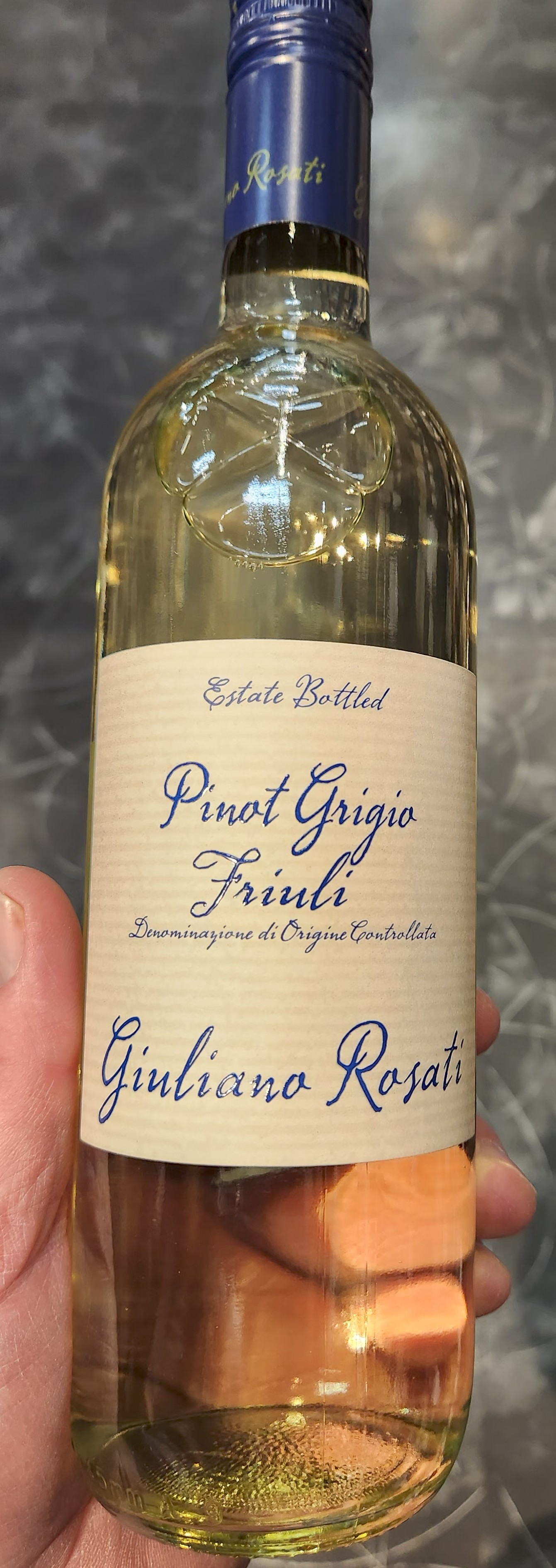
Giuliano Rosati leans back toward that older philosophy. Clean farming. Estate bottling. Letting the grape speak instead of sanding it down.
What’s in the glass (and why it tastes this way).
You get green apple up front, fresh citrus peel, and a subtle peach note—not sweet, not tropical. The key is the mid-palate. There’s actual weight here. A gentle phenolic grip that keeps the wine from feeling hollow. Acidity is crisp but not sharp. Think tennis, not boxing—placement beats power.
Why the 97-point score actually makes sense.
I don’t throw points around lightly, but context matters. This isn’t being judged against $40 white Burgundy. It’s being judged on typicity, balance, and value. At under $11, this wine is executing at a level most Pinot Grigios don’t even attempt.
Price reality check.
$12.99 retail is already fair. $10.99 with card is strong. $9.89 on a six-pack is the kind of pricing that rewards people who actually drink wine instead of collecting labels. This is everyday European thinking applied correctly.
Who this wine is for.
If you like Sauvignon Blanc but want less grass and more structure—this fits. If you drink Albariño and want something softer but still coastal—this works. If you’ve written Pinot Grigio off entirely, this is your friendly intervention.